How Different Industries Take Differing Paths to Advertising Success
The MSW Creative Gauge™ AI service evaluates the sales potential of advertising based on the content profile of the ad itself. That naturally raises a couple of important questions.
First, are some industries simply better positioned to succeed because of the kinds of content they can more easily include in their advertising? Creative Gauge accounts for this by using industry-specific norms, but the question remains: could the system still favor certain categories?
Second, does this type of measurement encourage formulaic advertising, implying there’s only one “right” way to build an effective ad?
To explore these questions, we analyzed hundreds of ads across a wide range of industries. Before getting into the results, though, here’s a quick overview of how Creative Gauge works.
The Creative Gauge System
Creative Gauge is powered by Meadow, MSW’s AI trained on decades of advertising research to identify the content most strongly associated with sales effectiveness.
Meadow applies this body of human-generated learning at scale, identifying and scoring key creative elements while recommending improvements almost instantly.
Using MSW’s proprietary Creative Effectiveness Score (CES) model, Meadow generates an overall CES Index along with indexes for four key advertising dimensions:
- Brand Messaging
- Emotional Connection
- Brand Linkage
- Advertising Structure
The Study
We collected ads from 20 different industries, including categories as varied as beauty care, automobiles, fast food, prescription pharmaceuticals, retail, furniture, and sporting goods.
For each industry, we analyzed roughly 30 recent video ads across multiple brands, limiting the sample to no more than two ads per brand. In total, hundreds of ads were evaluated using the Creative Gauge system.
What We Found
First, we looked at average CES results by industry. Instead of using the CES Index, which compares an ad to others within its own category, we examined the raw content scores.
The results were strikingly consistent.
Average CES scores for the large majority of industries fell within +/-10% of the overall average (gray shaded area in chart below). In fact, statistical testing showed that the household products average versus both the B2B and Financial Services averages were the only statistically significant differences between the categories at the 95% confidence level.
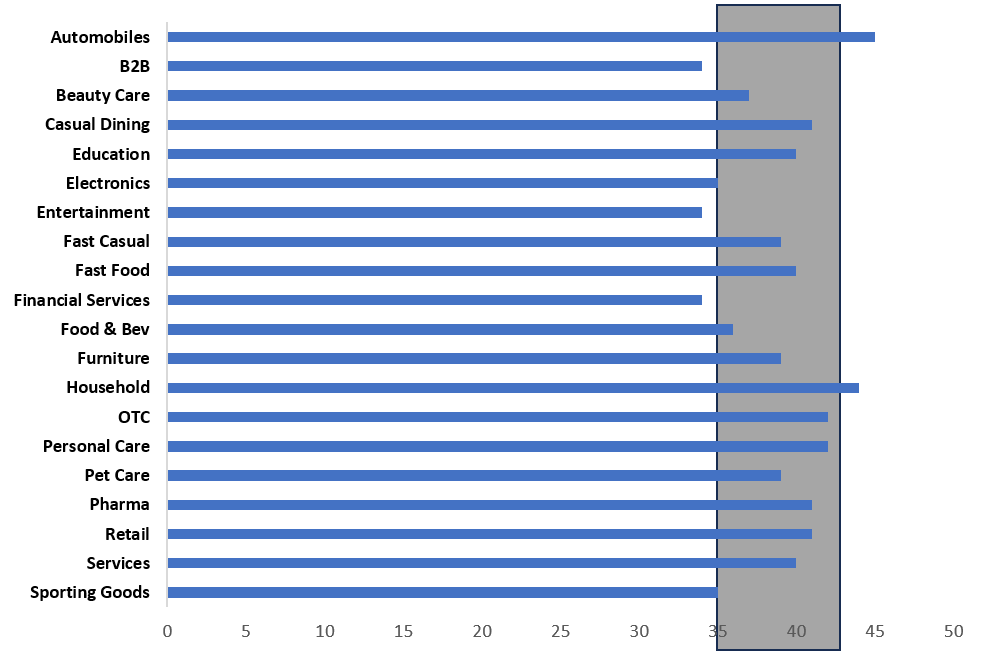
This suggests two important things:
- The CES model evaluates a very broad range of industries in a balanced way.
- Average advertising effectiveness is surprisingly similar across categories.
But that doesn’t mean every industry succeeds in the same way.
Different Industries, Different Strengths
To better understand how industries achieve effectiveness, we looked not just at overall CES performance, but at the four underlying dimensions.
While overall CES scores were relatively tightly grouped, the individual dimensions showed much greater variation across industries.
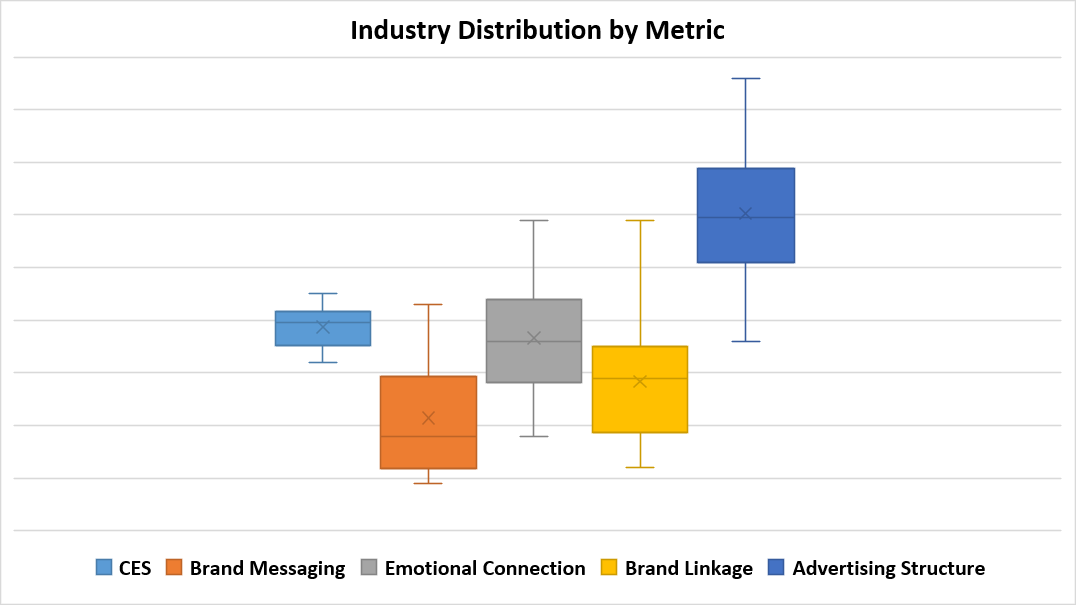
The implication is that while the average advertising effectiveness level is similar across diverse industries, the way they get there is very different.
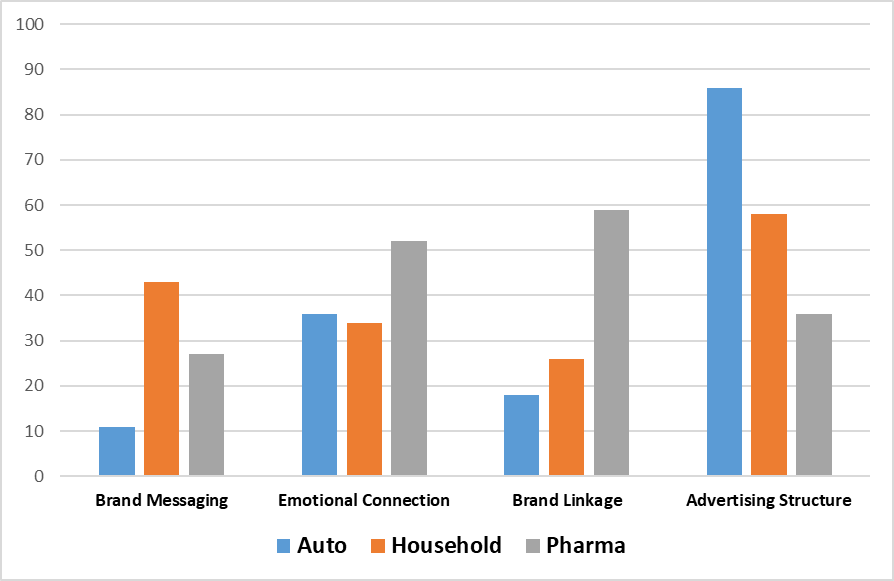
To make that a little more concrete, we contrasted average content levels by dimension for each of three diverse industries: Automobiles, Household Products and Prescription Pharmaceuticals.
Automobile Advertising: Structure Wins
Automobile advertising stands out on Advertising Structure, the dimension covering elements like demonstrations, settings, product focus, characters, results, formats and storytelling devices.
That makes intuitive sense. Car ads naturally showcase the product, its features, and the experience of interacting with it.
Household Products: Functional Messaging Matters
On the other hand, household product advertising tends to excel in Brand Messaging.
Consumers want cleaning products, batteries, air fresheners, and light bulbs to perform better than alternatives, so these ads lean heavily into functional information, demonstrations, and reasons to buy.
Pharma Advertising: Emotion and Linkage
Pharmaceutical advertising performs especially well on Emotional Connection and Brand Linkage.
Many medications genuinely improve people’s lives, and pharma advertising often taps into that emotional impact. These ads also tend to use extensive verbal and visual branding to strengthen memory linkage between the condition being treated and the brand itself.
When Brands Break the Pattern
One of the most interesting findings from the study is that some of the strongest ads succeed by leaning into dimensions that are not typically associated with their category.
For example, electronics advertising generally scores lower on Emotional Connection. Instead, these ads are typically driven by advertising structure, with the focus on the device itself and its features.
But a Fitbit ad in our sample stood out because it combined strong advertising structure with a highly emotional parent-child storyline… creating a well above average ad overall.
On the other hand, Pharma ads often score relatively lower on Advertising Structure while excelling on Emotional Connection and Brand Linkage. But an Opzelura ad in our study achieved above-average CES by emphasizing a clear and prominent product demonstration, problem/solution framing, and visible treatment results – a different path than typical pharma advertising.
If you’d like more information on this study or to see how Creative Gauge works in practice, we’d be happy to continue the conversation.