Pet care ads have one advantage over ads from other categories: they have pets in them. Most people find animals to be at least somewhat charming, and pet owners tend to be ga-ga for the fur babies. So, one would hope that ads for pet food purveyors have at least a decent chance of attracting the attention of their target audience by featuring those adorable companions we love to spoil.
But here’s the real question: how successful are they at getting pet owners to actually open their wallets for the latest nutritious meal or savory snack?
To find out, we took a closer look at the sales effectiveness of 18 recent ads from a range of pet care brands, one ad per brand, using the MSW Creative Gauge AI ad evaluation system.
Creative Gauge AI is unique in that Meadow, our AI, has been trained on decades of MSW research on what type of advertising content has been proven to be associated with sales effective advertising. Meadow leverages this vast array of human-generated knowledge to do what humans can’t… nearly instantaneously identify and score key content and make recommendations on how the ad could be made even better.
Utilizing MSW’s proprietary Creative Effectiveness Score (CES) model, Meadow provides an index summarizing overall ad strength (CES Index) as well as indices for four subcomponents:
- Brand Messaging
- Emotional Connection
- Brand Linkage
- Advertising Structure
Overall Performance
Let’s start with the big picture.
We looked at 18 ads in total, mostly from dog and cat food brands, along with two from traditional retailers (PetSmart and Petco), and one from an online retailer (Chewy).
A quick note on how to interpret the results: the CES and subcomponent scores are benchmarked against historical norms for the pet care category. So, while many of these ads may tug at pet lovers’ heartstrings, the bar for achieving outstanding emotional connection is high in this category because the norm is high.
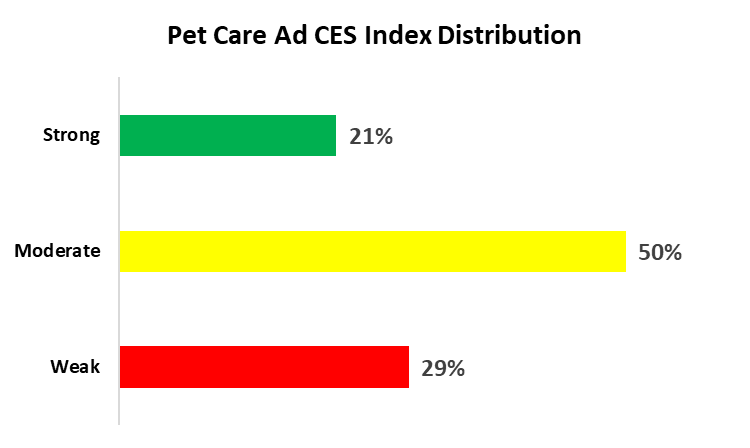
Overall, these ads actually skew slightly to the weaker side. Only about 1 in 5 would be considered strong in terms of selling power within the category.
This distribution is consistent with what we see across all categories of ads. Our data shows that across all categories
- 43% of advertising is maintenance. It keeps the lights on but does little for the brand.
- 31% is simply bad. It wastes money and attention.
- Only 26% is truly effective at driving growth.
That means nearly three quarters of advertising spend is not pulling its weight
The results for this category are consistent but skew even more to the bottom with 79% not pulling their weight vs. 74% for all ads.
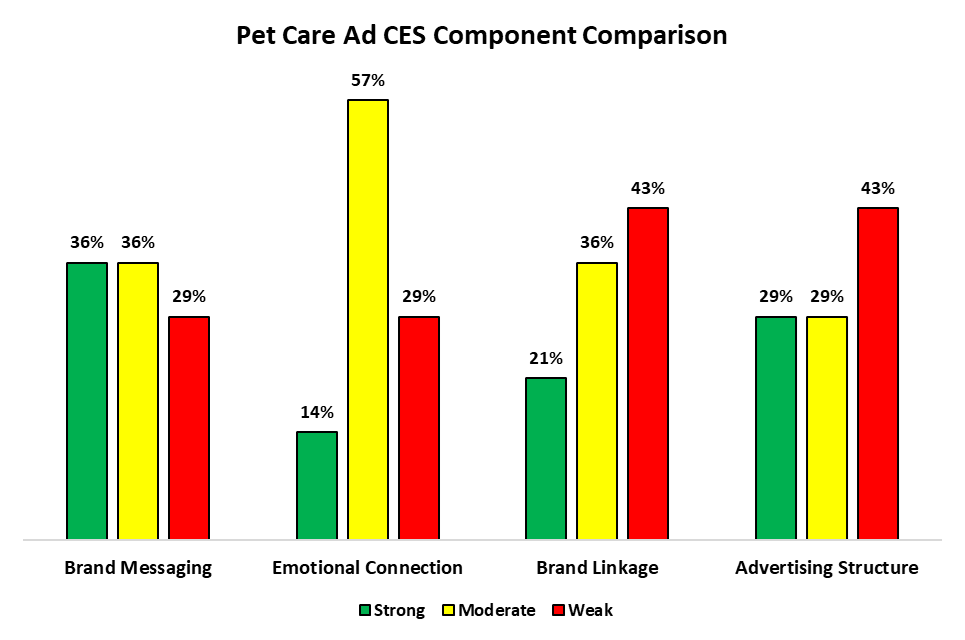
Looking at results by subcomponent, most ads achieved a level of Emotional Connection typical for pet care advertising. The one dimension where these ads skewed somewhat more positively was Brand Messaging:
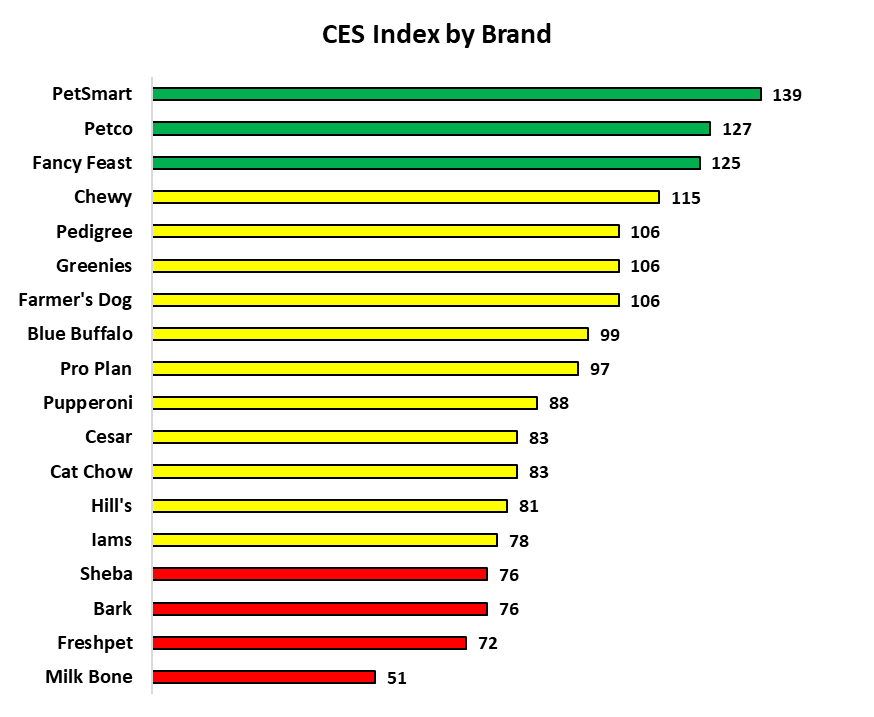
At the individual brand level, the two retailers stand out among this set of ads:
Examining the Best and Worst
The strong-performing PetSmart ad takes a relatively rational approach, and as a result, generates one of the lower Emotional Connection scores in the set. The spot takes aim at online providers, making the case that “PetSmart has auto-ship too… and so much more,” with the customer ultimately conceding, “you’re like the full package.”
The result? An ad with above average Brand Messaging, Brand Linkage, and Advertising Structure and strong overall sales potential.

On the other end of the spectrum, the lower-scoring Milk-Bone ad actually performs reasonably well on Emotional Connection. It features several dogs frolicking across a plain red background, which, to be fair, is inherently appealing.
But that’s where things fall short. The ad delivers little else, resulting in very low scores across the other key dimensions.

Fresh Pet Food Subcategory Ad Comparison
Two ads represent the relatively new fresh pet food subcategory, an area ripe for differentiation from more traditional pet food options. But only one of the ads really takes advantage of that opportunity.
The Farmer’s Dog ad leans directly into the contrast, opening with: “Most pet food looks like this. But not The Farmer’s Dog. It looks like real food…” It reinforces this with, “…to give your dog the nutrients they need, without the ultra-processing.”
Freshpet, by comparison, communicates quality but without clearly distinguishing itself from traditional alternatives.
This difference is reflected in the sharply divergent Brand Messaging results, as seen in this shot of the Creative Gauge dashboard:
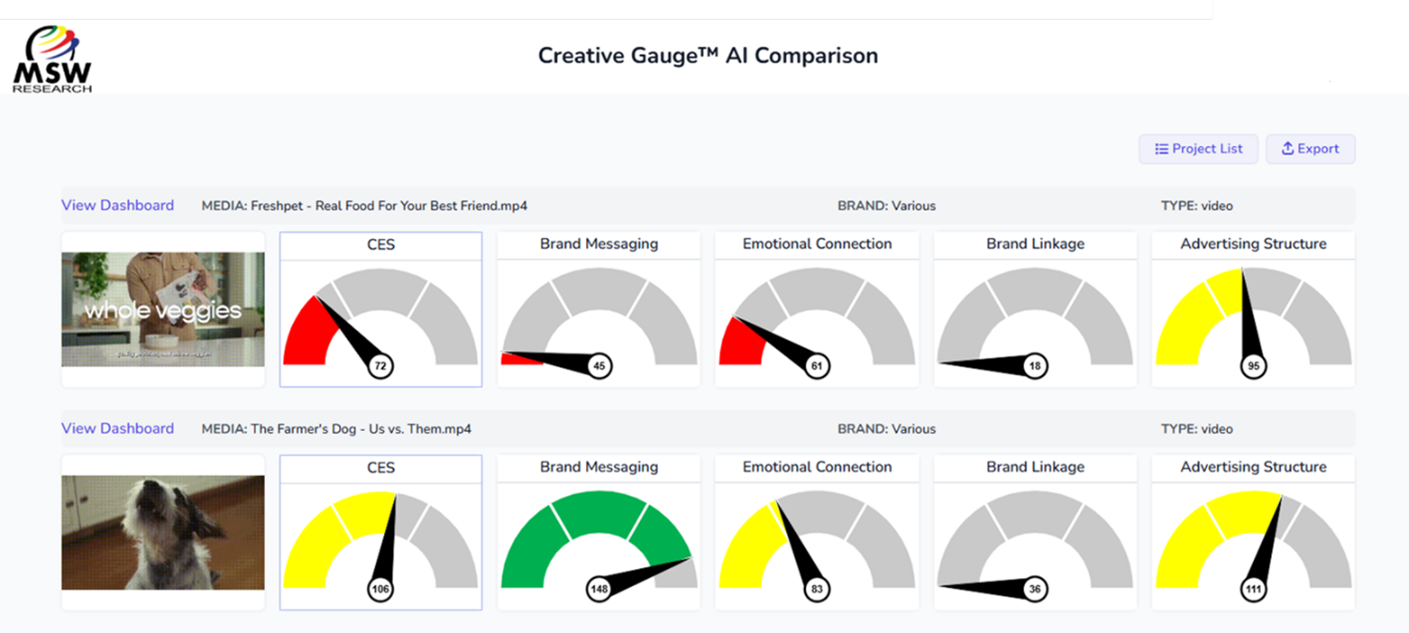
Notably, both ads perform poorly on Brand Linkage, an especially important factor for relatively new brands in an emerging subcategory. This limitation prevents The Farmer’s Dog ad from achieving a “great” overall score, instead landing in the “good” CES range.
Final Thoughts
So, what’s the takeaway?
Even in a category where emotional appeal comes naturally, strong creative doesn’t just happen. The difference between ads that are merely likable and those that actually drive sales often comes down to how well they deliver across all key dimensions.
If you’re concerned your ads might be leaning toward the ARFul side, Creative Gauge can help diagnose where they’re falling short and provide clear recommendations to make them more PURRfect.
If you’d like to learn more about this study or see how Creative Gauge works in practice, we’d be happy to continue the conversation.